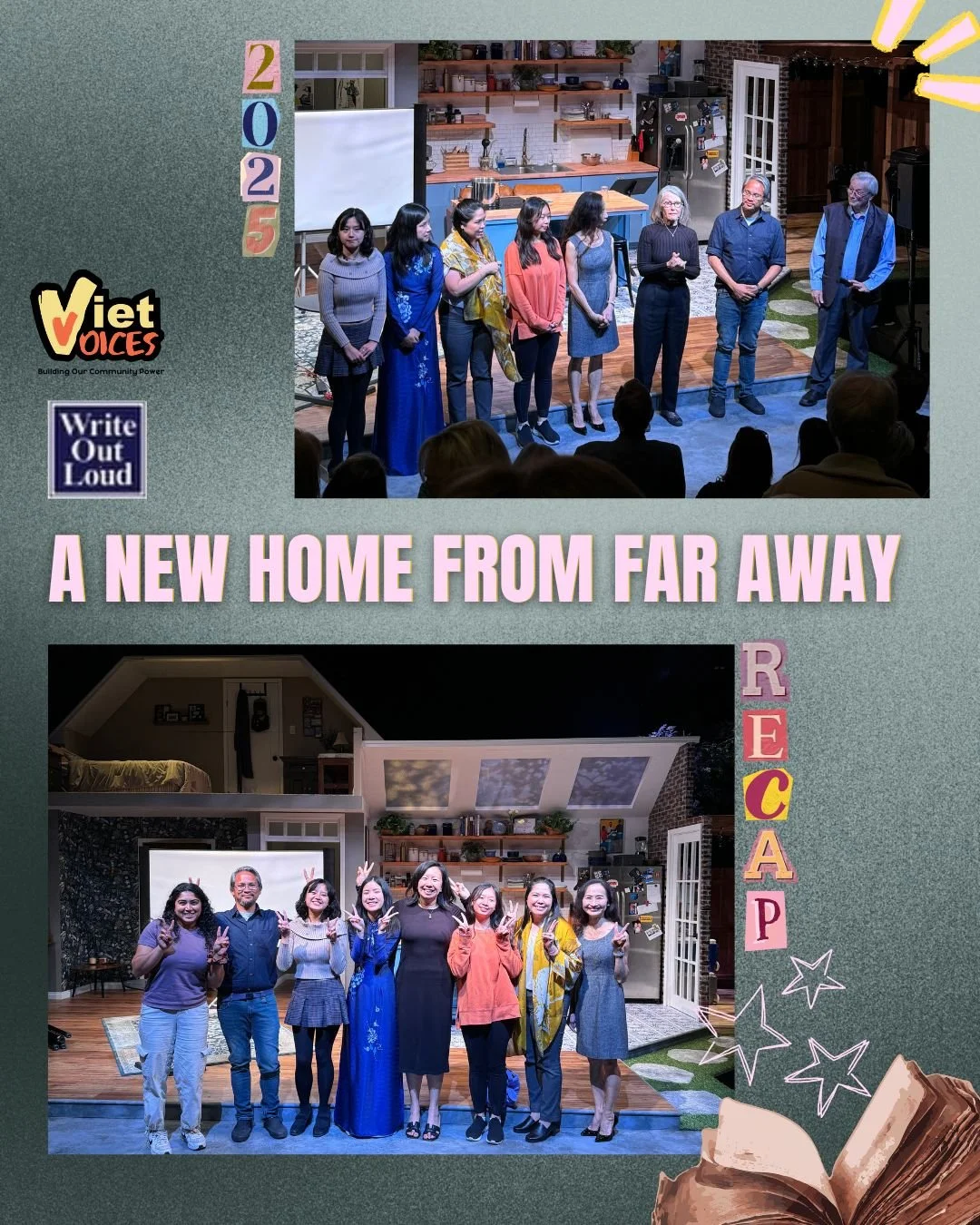
New Home From Far Away
In the time when immigrants and refugees are being treated with violence, it is important to document our immigrant stories. Here is another one from the 5 volunteers that we worked with to share their stories at the event, "A New Home from Far Away" (partnered w/ Write Out Loud).
"the story of kim matlin"
🇻🇳
"the story of mimi phung"
🇺🇸
"A Letter to my daughters"
🇻🇳
“Do What We Can for Who We Can: Luc and Chau Nguyen”
🇺🇸
"an anonymous story"
🇻🇳
"the story of kim matlin" 🇻🇳 "the story of mimi phung" 🇺🇸 "A Letter to my daughters" 🇻🇳 “Do What We Can for Who We Can: Luc and Chau Nguyen” 🇺🇸 "an anonymous story" 🇻🇳
“I feel like an American. I’ve been here for fifty years, after all. My husband is an American, and I have American kids. I’ve had to deal with American in-laws. And my friends have mostly been American people. I came here when I was sixteen, and have lived on the East Coast, the Midwest, and now the West Coast. In all the places I’ve lived in this country, there were never a lot of Vietnamese people nearby. But I came to the US with my brothers and sisters, and there were nine of us, so you could say we were our own little Vietnamese community.
My journey to the US began on April 10, 1975. I was sixteen and lived with my siblings and cousins in Bao Loc. My parents had both passed away recently. My aunt worked for an American company, and she arranged a helicopter to bring my uncle to our home so he could help us begin the trip. It was a long journey. After leaving Bao Loc, we had to make 2 stops before arriving in Saigon, where we had to wait three more weeks to get on the boat. We left Vietnam on April 30, 1975, the day Saigon fell.
We ended up in a camp in Subic Bay, in the Philippines, and then a camp in Guam. I remember being treated well in both places. There was always lots of food, and there would be social events like movies on the beach. My siblings and I stuck together, though. We ranged in age from 22 to 2 and a half, and only left our tent for meals. In the US, we ended up at the refugee camp in Fort Indiantown Gap, Pennsylvania. It was hard to find a sponsor who would support all nine of us, but I had an uncle who was a priest at the UN, and he was able to help us find someone in Fishkill, New York.
I’ve come a long way since those first days. I was so young when I arrived, but I wasn’t I didn’t know any better. My life started in Vietnam, and the course of history made me American. And I can tell I’ve changed. I’m different from other Vietnamese people in the way that I consume information and the way I see the world. I even get frustrated because I want to talk back to elders. That’s the American in me.
Of course, I’m still Vietnamese. I thought I was pretty progressive While I was raising my daughters but apparently I was strict compared to their friends’ parents. And I definitely don’t show affection the way my American friends do, with all that hugging and kissing and talking about our feelings. That’s not my style.
But most of all, even 50 years after leaving, every time I go back for a visit, the smells, the surroundings, and the people remind me of who I am. I am Vietnamese, after all.”
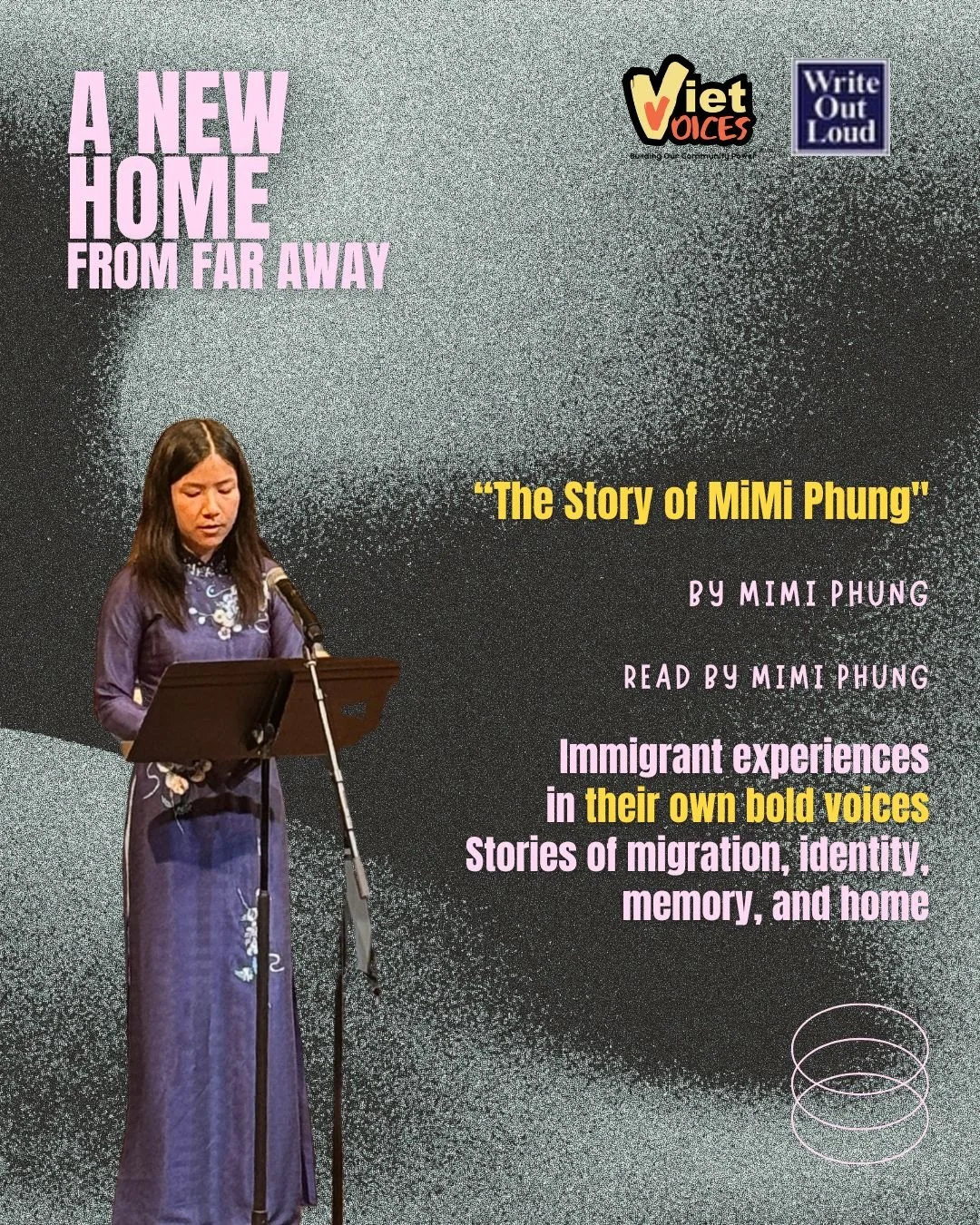
“My parents owned a nail salon for nearly thirty years. If you’ve ever owned a business, You know that the work never stops. They were at the nail salon all the time, working hard so that they could give me and my sisters everything, because they’d grown up with so little. The classic immigrant story, right? Sometimes I worked there too - I’d answer the phone or make change for customers, and I hated it at the time, but now I think back on it fondly. I think this is because We didn’t get much time together at home, because they worked so much, and as an adult, I’ve realized how short time is with our parents.
My sister was 12 years older than me, and she was my main parent. She picked me up from school, made me dinner, and helped me with my homework. She had to, because my parents were always grinding away to make a life for us. What does it mean to be Vietnamese-American? What burden do we carry as part of a people who have suffered brutal injustices by colonizer after colonizer, For hundreds of years? And when we find ourselves with newfound privilege, what obligations do we hold? I believe that we can honor our parents’ journey by continuing their legacy of resistance and perseverance.
I’m grateful for what my parents did for our family, but all that work came With a cost. We missed out on spending quality time together and getting to know each other. There are so many moments we can’t get back. My parents weren’t the first people in their families to have to work so hard, but hopefully, they’re the last. They were able to build a life here, to find safety and security here. I want to make sure others have that same right, no matter where they're from.”
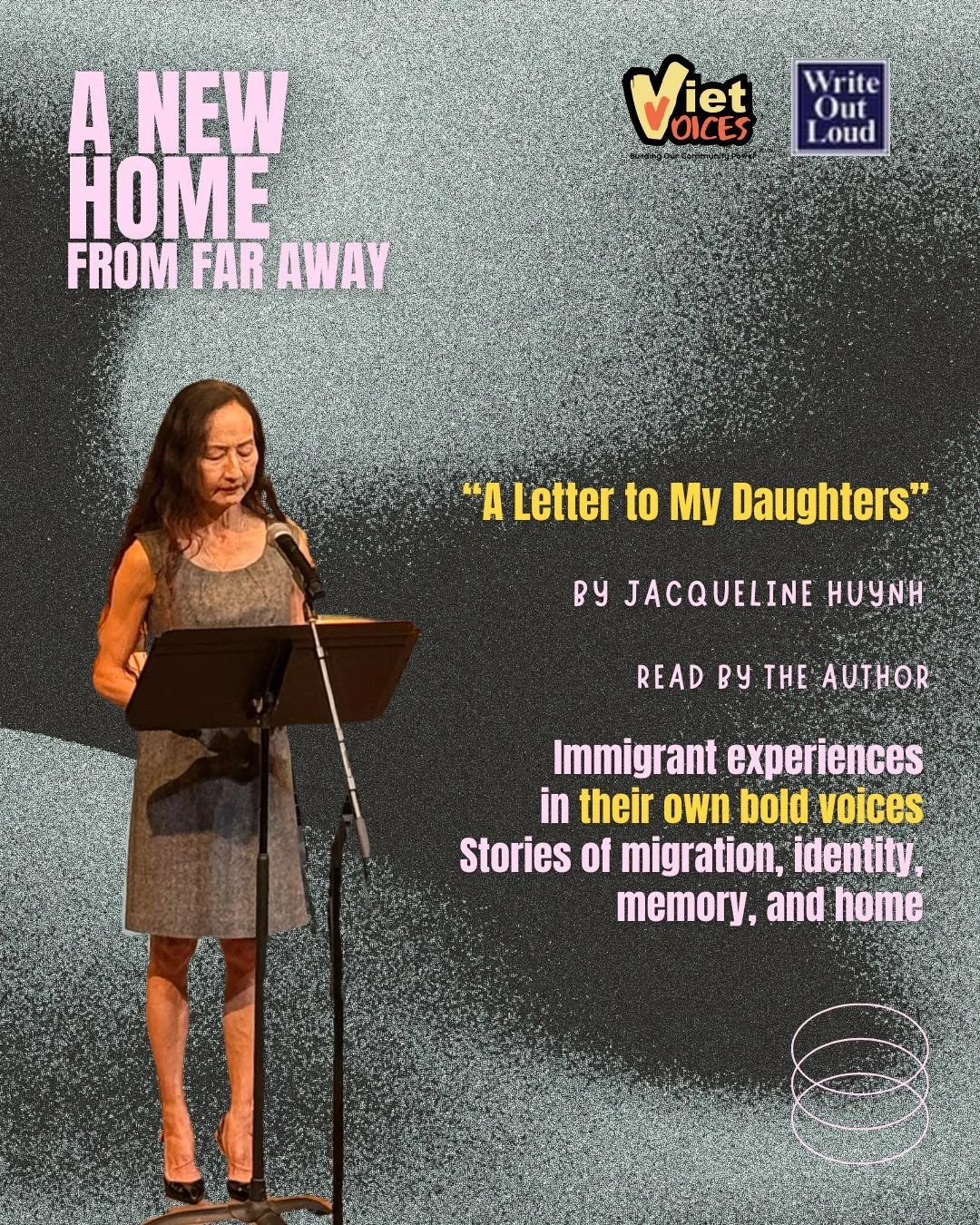
“When I was nine, your grandparents, aunt, and I fled South Vietnam. It was the night of April 30, 1975, when South Vietnam fell to the communist North Vietnam. We were what you know today as the “boat people”. remember bits and pieces of that night and the days to follow. Chaos and fear were seen and heard in every corner as hundreds of thousands of people fled for their lives. I remember seeing my dog standing on the dock as she watched us leave. I did not have any close friends because your grandfather was in the military and we moved around often, nor did I have a nurturing relationship with your grandparents, so my dog was my only childhood companion. I remember vividly seeing a helicopter get blown up right in front of my eyes. I didn’t know how, nor was I given space to safely process the traumatic event of that night until many decades later.”
“When I was nine, your grandparents, aunt, and I fled South Vietnam. It was the night of April 30, 1975, when South Vietnam fell to the communist North Vietnam. We were what you know today as the “boat people”. I remember bits and pieces of that night and the days to follow. Chaos and fear were seen and heard in every corner as hundreds of thousands of people fled for their lives. I remember seeing my dog standing on the dock as she watched us leave. I did not have any close friends because your grandfather was in the military and we moved around often, nor did I have a nurturing relationship with your grandparents, so my dog was my only childhood companion. I remember vividly seeing a helicopter get blown up right in front of my eyes. I didn’t know how, nor was I given space to safely process the traumatic event of that night until many decades later.”
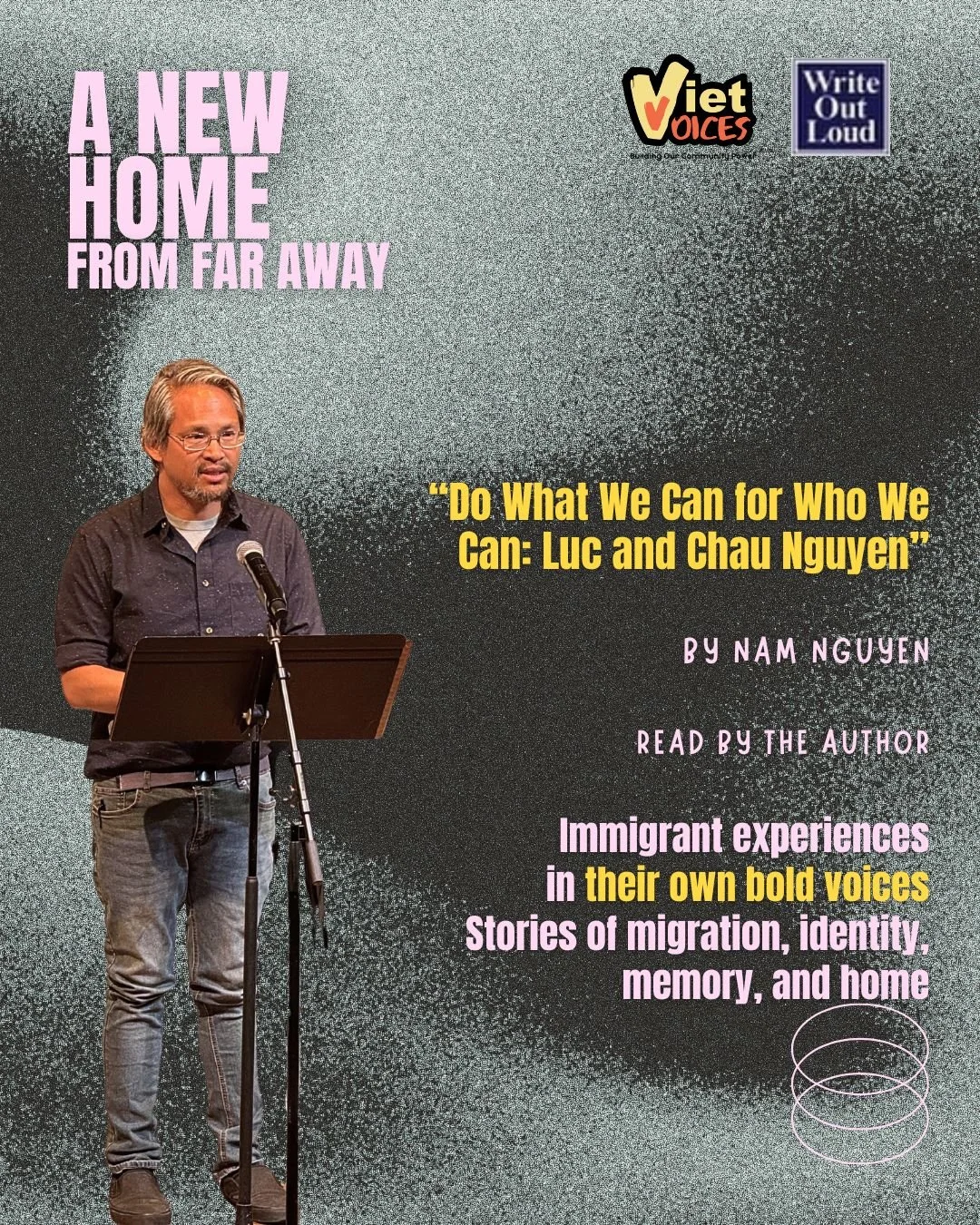
“I have photos of my parents’ honeymoon in Yellowstone. They’re bundled up in winter clothes, snow on the ground. In one picture, they’re standing posed in front of Old Faithful. In another, My mom has an embarrassed smile on her face, as if she’s thinking that her new husband is ridiculous for taking yet another picture of her.
They’d met at Camp Pendleton, at the refugee camp. My mom was standing in line at the cafeteria, waiting to get some food, when a guy cut in front of her. She was a quiet, reserved person - she wasn’t going to say anything. But my dad saw what happened and strolled up, cock of the walk, and told the guy to get in the back of the line. The guy stared at him. My dad stared back. The guy went to the back of the line.
Months later, my parents started a new life together in San Jose. A few years later, my sister and I came along. Our parents taught us how to care for the people around us, and help our community build resilience. And they did it in very different ways.
Nowadays in San Jose, You can’t get elected without the Vietnamese vote, and this is a legacy of my dad’s work. Loud and boisterous, but humble and deeply empathetic, he brought the Vietnamese community together to coalesce its political power. He organized meetings to educate the community on the issues that pertained to us. He organized fundraisers to Help save the Boat People: thousands and thousands of fellow Vietnamese brothers and sisters who desperately took to the seas to escape a dangerous homeland. To give them, and those already in America a measure of hope and joy, he coordinated festivals to keep our culture alive. There’s a picture I have, somewhere, of my dad on a stage with dignitaries and leaders, in front of a giant Tet banner, 50 - 60 feet tall, before a crowd of thousands. My dad was a trusted member of the community who knew everyone and had a guy for everything. He taught me that real, long-lasting resilience as a community depends on people supporting each other. Once you reach a level where you can help your neighbors, it’s your responsibility to do so. And my mom also looked out for the people she cared about, but in a different way. She was bookish and pragmatic, and knew that for Vietnamese people, or anyone, to succeed here in America, We needed to build capital, be financially independent. While my dad was out galvanizing the community at meetings and protests, my mom was learning about taxes, investing in the stock market, and other practical knowledge that she forged into a small fortune to never let her family starve, Never let them sleep in the streets, and never let her children live in uncertainty. My mom had been just a couple months away from finishing medical school when she’d left Vietnam. Forced to start over, she found a new way to serve, so that we could all be stronger in the long run.
My parents used their own unique strengths to create fortitude within the Vietnamese American community and the story written in American history. When I think about my parents making a life here, I’m inspired by the way they kept our culture alive while building our strength for the future.”
“I emigrated to the US When I was six years old. The feeling of being an outsider was instantaneous as no one looked like me, spoke the same language or shared the same experience. In my elementary school in the Chicago suburbs, I was one of two Asian kids. There was also one Black kid, and everyone else was white. The students had not seen many kids that looked like me and would make fun of my name and my inability to speak English. These were just some of the challenges, but I never felt sorry for myself. Instead, I did my best to act strong and unflappable. I was driven to show my classmates that I was just as worthy as they were and not back down or be intimidated. I still have this drive today, and I learned this strength from my mother.
She and I left Vietnam in 1974. My brothers joined us the following year. But my father couldn’t come until 1990, because he was incarcerated by the new communist government. By then, I was a grown man, and we had essentially become strangers to each other. He didn’t even recognize me when he arrived.
This isn’t to say we weren’t a family during that time apart, though. My mother still managed to take care of him. Every month, for all those years, she would scrimp and Save to send my father a care package filled with canned food, snacks, and treats, as he was held in a “re-education camp” with limited food and no way to communicate with family besides a letter a once or twice a year So we know that he is alive. She was shrewd and strategic, knowing that the guards were probably as deprived as their prisoners. If they knew that a box of food came regularly, Maybe they’d go easier on him. It might be the reason he survived. Even with oceans between them, my mother found a way to look out for her husband. And she did the same for me and my brothers here in the US.
In Vietnam, our family had influence, both politically and financially. In the US, our lives were completely reversed. We came to the US with just the clothes on our backs and nothing else. We lived in an old, broken-down, rodent-infested house with creaky floors. But my mother, who suddenly became a single mother of 3 young children living in foreign land with no English skills, was still the rock that held us together through the most trying time anyone could imagine. There was never a moment that she showed her kids any signs of distraught or defeat, but I’m sure she endured much emotional pain in private. Even though we struggled, we always had food on the table. In the face of adversity, she used her sheer willpower to push through anything or anybody that stood In her way.
She always uplifted her children to continue to persevere in times of extreme hardship to overcome and hold our head up high because she never let anyone treatus as less than, and Conversely, she always treated everyone around her with respect. She carried herself with great self-confidence and esteem until the day she died, And I learned to keep moving forward because of her.”